Eight charts that explain the water-energy paradox of microirrigation — and what growers can do about it.
More than half of all irrigated farmland in California now runs on drip or microirrigation. That transformation is one of the most significant changes in the state's agricultural history — driven by water scarcity, regulation, and the economics of high-value crops. The water savings are real.
But there is a side of this story that rarely gets told: farm electricity use has not fallen. In many cases it has risen. And as California electricity rates continue to climb, energy is becoming one of the most significant and least-managed operating costs in irrigated agriculture.
This page walks through why — and what growers, advisors, and policymakers can do about it.
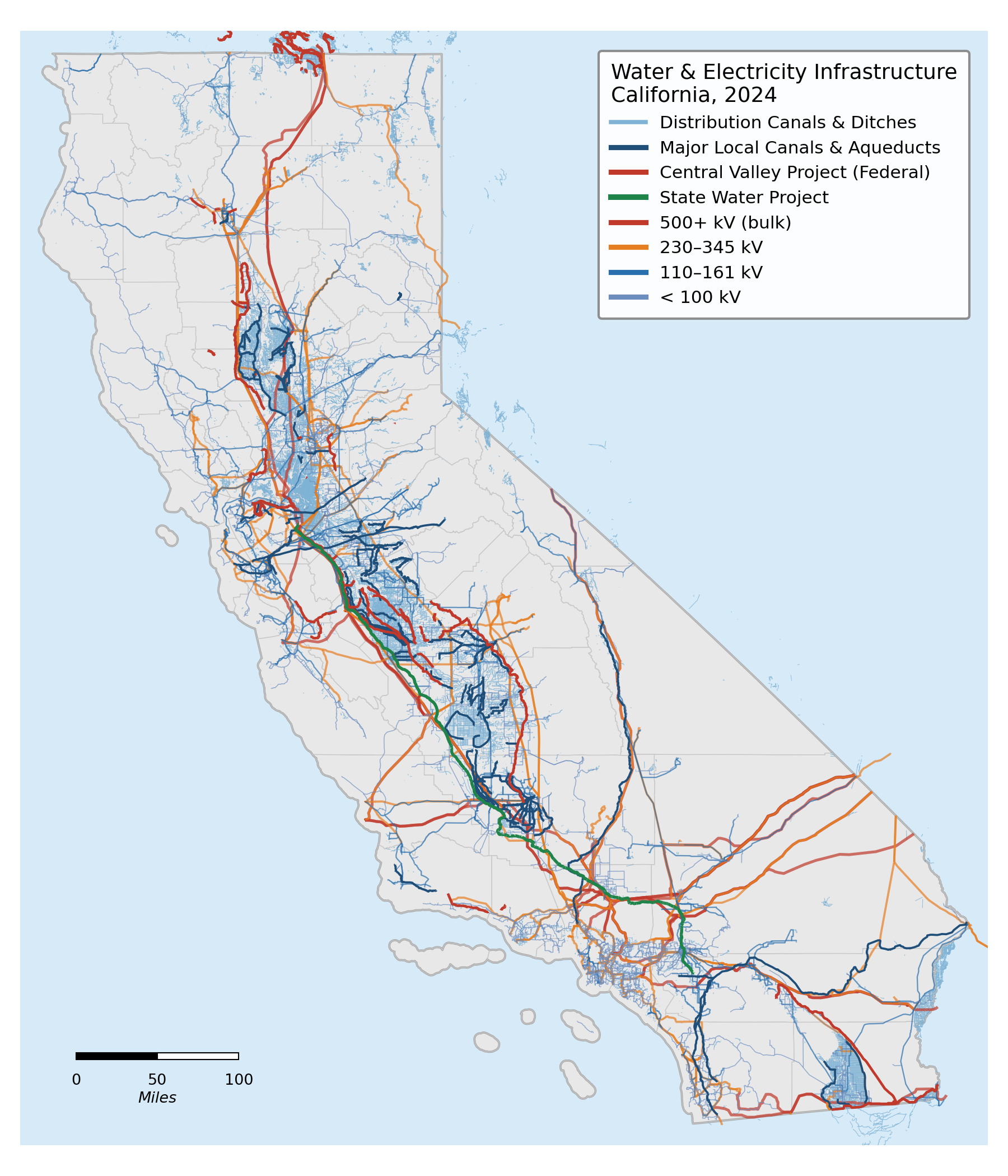
Agriculture uses approximately 80% of California's developed water supply. Pumping, pressurizing, and moving that water consumes about 7% of the state's total electricity[1] — making agriculture and water pumping one of California's largest electricity end-use sectors. California's electric grid and its water conveyance infrastructure are deeply intertwined: the State Water Project, the Central Valley Project, and the Metropolitan Water District alone account for roughly 40–50% of all agricultural and water pumping electricity in the state.
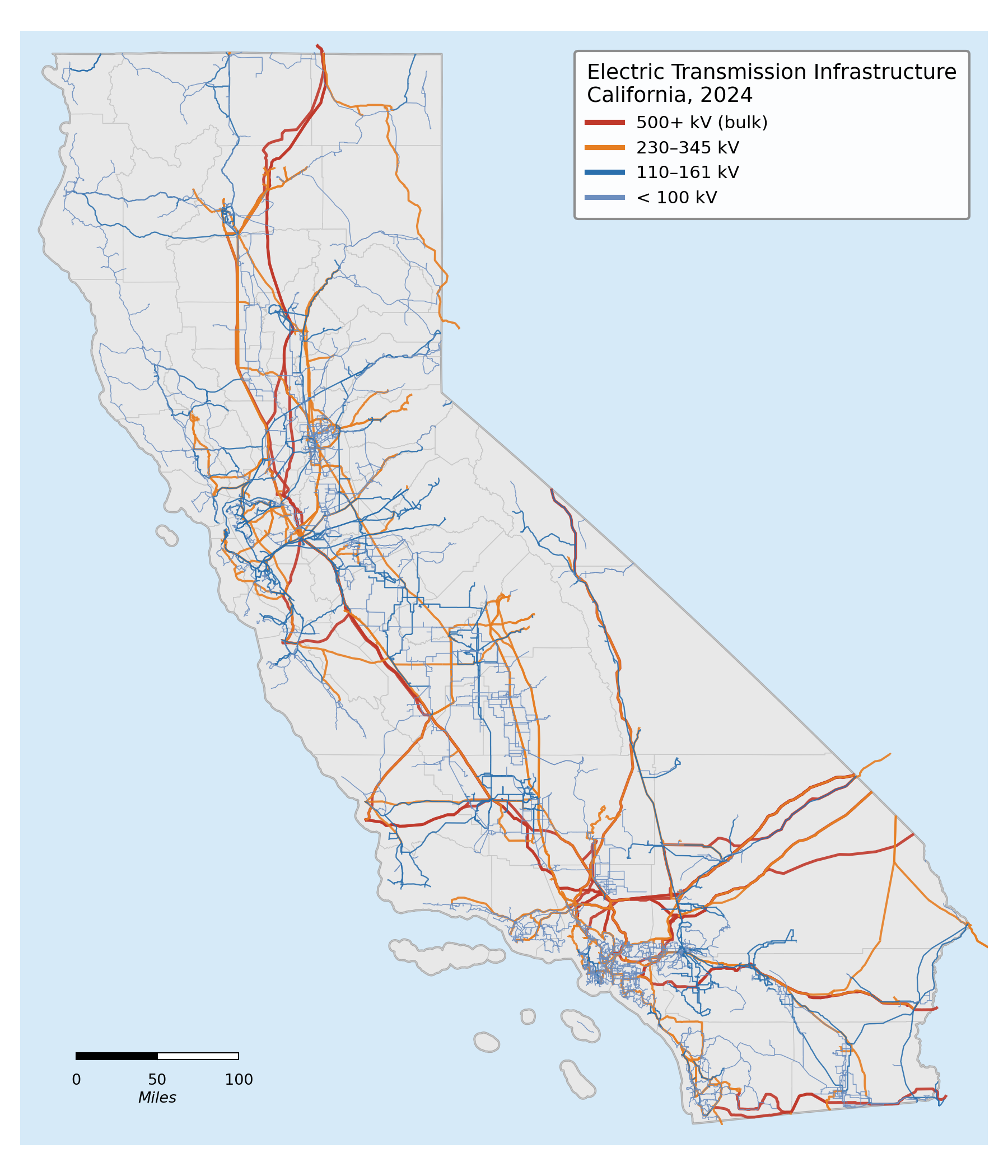
California's water conveyance system and its electric transmission grid trace the same state. Both look like arteries and capillaries moving a vital commodity. But beyond the geometry, they could not be more different — in age, in speed, in how much capital is invested in them, and in how accurately their output is priced.
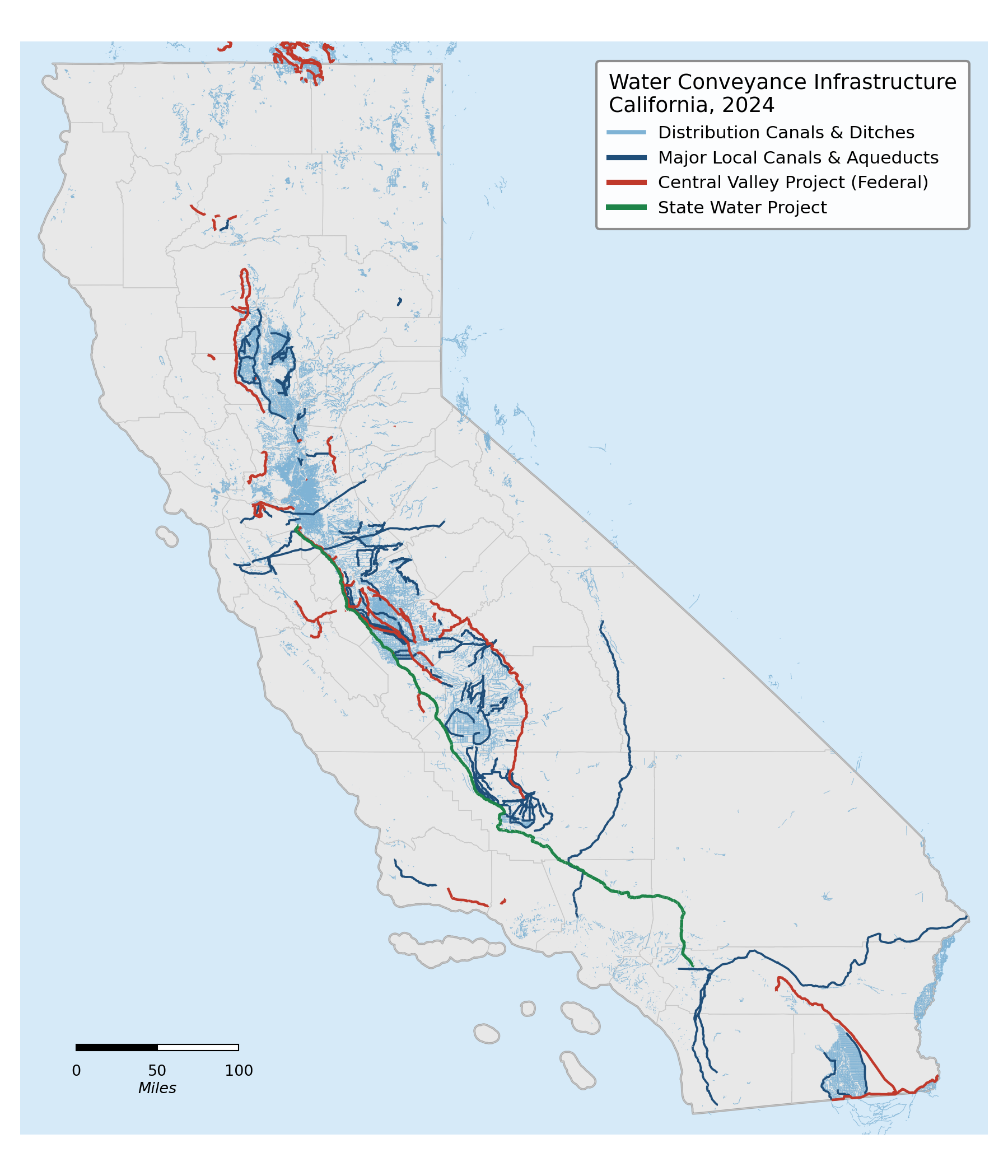
Despite these vast differences, California's water and electric systems are among the most mutually dependent infrastructure networks in the state. Water cannot move, be treated, or be pressurized without electricity; electricity, in turn, cannot be generated at utility scale in California without water.
According to the USDA Farm and Ranch Irrigation Survey,[3] drip and microirrigation covered essentially zero California acreage in 1969. By 2023, those systems account for 4.36 million acres — 56.2% of all irrigated farmland in the state. This transformation is one of the most significant changes in California's agricultural history, driven by water scarcity, economic pressure on high-value crops, and regulatory requirements.
On-farm irrigation electricity consumption has grown at a rate of approximately +131 GWh per year since 1990, even as water-use efficiency per acre improved substantially. The trend line runs upward through drought years when groundwater pumping surges and continues in wet years as expanded pressurized infrastructure maintains baseline consumption.
Agricultural groundwater pumping nearly doubles between wet years and drought years — from approximately 9 million acre-feet in normal years to 17+ million acre-feet during drought.[7][8] The upward trend line (+0.14 MAF/yr) shows that even between drought cycles, baseline groundwater reliance is rising. Drip systems require on-demand water supply, which rotational surface water deliveries cannot always provide — pushing growers toward groundwater.
You might expect that as microirrigation expanded — delivering water more precisely, with less waste — farm electricity demand would fall. That is not what happened. When we correlate drip and micro acreage share against on-farm electricity consumption, the relationship is statistically significant and positive: r = 0.772, p = 0.042.[4]
As drip share grew from 13% to 56% between 1994 and 2023, farm electricity demand rose — not fell.
As microirrigation share grew from 13% to 56% (1994–2023), farm electricity demand rose — not fell. The correlation is statistically significant (r = 0.772, p = 0.042). Three forces drive this counterintuitive result.
Every drip system requires on-farm pumps, filters, pressure regulators, and pressurized mainlines and laterals — infrastructure that gravity-fed flood systems do not need.[5]
Drip requires on-demand water. Most surface water delivery is still rotational and schedule-based. Growers who convert to drip often fall back on groundwater, which is available 24/7 and pressurizable — but energy-intensive and depth-sensitive.[6]
Agricultural groundwater use nearly doubles between wet years and drought peaks. Every additional foot of lift costs energy — and as water tables drop, pumping energy per acre-foot increases exponentially.
Agricultural electricity rates in California have roughly doubled to tripled in real terms since 2008,[9] depending on the rate schedule. The largest increases — up to +197% for interruptible and time-of-use rates — have hit large agricultural consumers hardest. Two structural forces are driving this:
The same forces raising costs have created a daily price pattern most growers don't know about. California has built so much solar that by midday, generation routinely exceeds demand — and wholesale prices frequently go negative.[10][11] The grid is paying to move electricity off the system. At the same time, evening prices spike as solar fades. This "duck curve" is a structural feature of the California grid — not a temporary anomaly.[11]
For irrigation operations: shift pump load toward midday hours when power is cheap or surplus, and away from morning and evening peaks. The agronomic scheduling decision and the energy cost optimization decision are the same decision.
Agricultural irrigation load has a property most electricity users do not: it is large, flexible, and increasingly schedulable. California growers are sitting on one of the most valuable grid assets in the state — a large pool of dispatchable, shiftable demand — and most of them don't know it.
| Program / Tool | Type | What It Offers | Administrator |
|---|---|---|---|
| TOU Rate Schedules[9] AG-V, AG-4C, AG-5C |
Rate | Substantially lower rates during off-peak and midday surplus hours. No enrollment required — just reschedule pumps. | PG&E, SCE, IID |
| Base Interruptible Program (BIP)[12] | Demand Response | Monthly bill credits for committing to curtail load during CAISO grid events. | PG&E |
| Emergency Load Reduction (ELRP)[13] | Demand Response | Risk-free payments for voluntary curtailment. No penalty for non-performance. | PG&E, SCE |
| Automated DR (ADR)[12] | Demand Response | Hardware incentives for automated pump curtailment systems. | PG&E |
| Yield Energy (formerly Polaris)[14] | Aggregator | Turnkey enrollment and dispatch. ~350 ag facilities, ~65 MW in Central Valley. | Third-party |
| AgFIT / Hourly Flex Pricing[15] | Rate Pilot | Real-time wholesale price signals. 40% peak-hour shift achieved in pilot. | Valley Clean Energy |
| USDA REAP[16] | Generation | Grants up to 50% of on-farm solar cost, max $500,000 per project. | USDA Rural Dev. |
| SGIP[17] | Generation | Rebates for behind-the-meter battery storage. | CPUC / IOUs |
| CORE Vouchers | Equipment | Vouchers for electric ag equipment, including pump motors. | CARB |
California's microirrigation transformation has been a genuine water efficiency success. The energy picture is more complicated. Pressurization requirements, greater groundwater dependence, drought amplification, and independently rising electricity rates have combined to make energy one of the most significant cost pressures in irrigated agriculture — and those pressures are structural, not cyclical.
The farms that will manage this well are the ones that treat energy as a strategic input — not just a utility bill. Microirrigation ROI calculations need to include energy cost projections, rate schedule optimization, and demand response revenue potential alongside water savings. The water savings alone are real, but they don't tell the full story.